
Selecting Carpet
Carpet is the most popular and bestselling floor covering option in the United States. According to the city of Dalton, around 90% of carpeted flooring world-wide is made within 65 square miles of Dalton, Georgia! Unbeatable in comfort, carpet is beloved by many in the flooring industry because it’s what started it all.
In this guide, we’ll go over the basics of carpet. Books can be written (and in fact, many have) about carpet. But we’ll focus here broadly on how carpet is made, what carpet is made of, and the different styles carpet comes in. In those sections you will learn about carpet and its wear characteristics and durability to help you understand the best carpet for your floors.
If you’re just interested choosing a rug, we have a guide for that by clicking here. If you’re only curious about carpet pad, we have a guide for that by clicking here.
Now, let’s talk carpet!
What is carpet?
Carpet is so common that it’s might sound silly to ask exactly what it is. Like any subject, it’s best to understand the simple fundamentals. Carpet is basically two layers: The top side, which is the face yarn; the soft side you see and feel. Then the bottom side, which is the backing; a glued mesh grid (like a net) of fibers that secures the top yarn and provides dimensional strength. So, a simple definition of carpet is the following: carpet is a continuous set of yarns secured to a structural backing (used for floor covering).
How is carpet made?
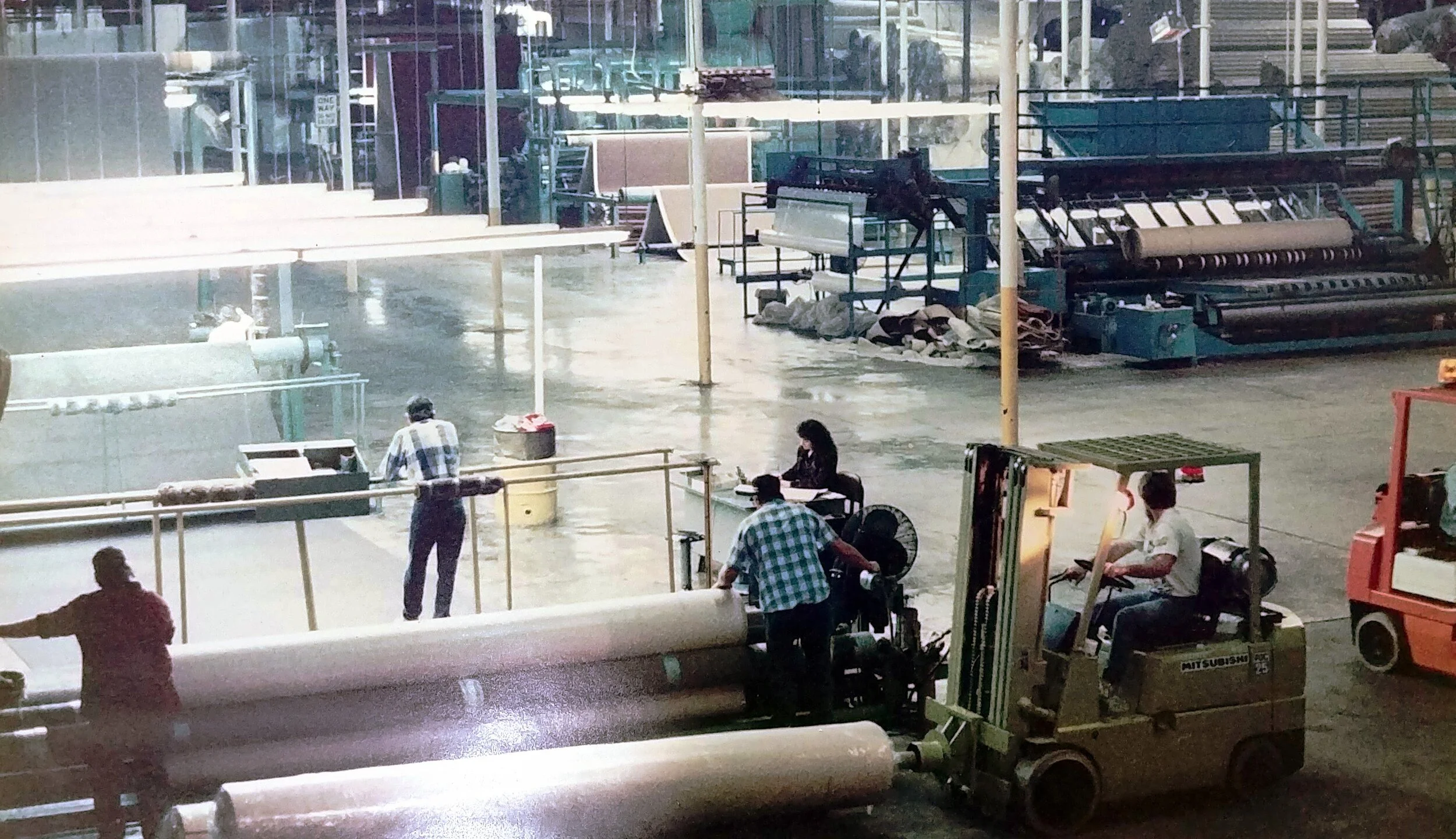
Carpet mills revving up. Inside Diamond Carpet Mill, 1989. In the far back of the picture you can see a continuous roll of carpet after it leaves the tufting machine. The carpet is then cut, wrapped, and stored or prepared for logistics.
The major majority of carpet today is “tufted”. Unlike the rugs and carpet of the past, carpet is very seldom woven. Instead the face yarn is tufted into the backing. To picture it, imagine a basic sewing machine with one needle. Now imagine enough sewing machines put side-by-side to be 12 foot wide, but with about 300 or more needles total. Each of those needles punch the yarn through a long roll of backing. Those needles leave a bunch of compact loops of yarn sticking out on the face side. Think of a big vertical loop on a roller coaster, that loop is somewhat like the yarn loops sticking up from the backing when carpet is tufted.
The yarn sticking up from the backing is called the pile. Carpets of every face and style can be made based on those pile loops. For example, shag carpet is made with those same pile loops, but the pile loops are cut. When the pile loops are cut, the carpet stands up like grass, as so you’d never know the loops were there. Berber carpet is tightly looped carpet with the loops left in. Carpets can even be can be “sculpted” by varying heights of the pile yarn or cutting only some of the loops to form a pattern. In the styles of carpet section, we go over this is more detail.
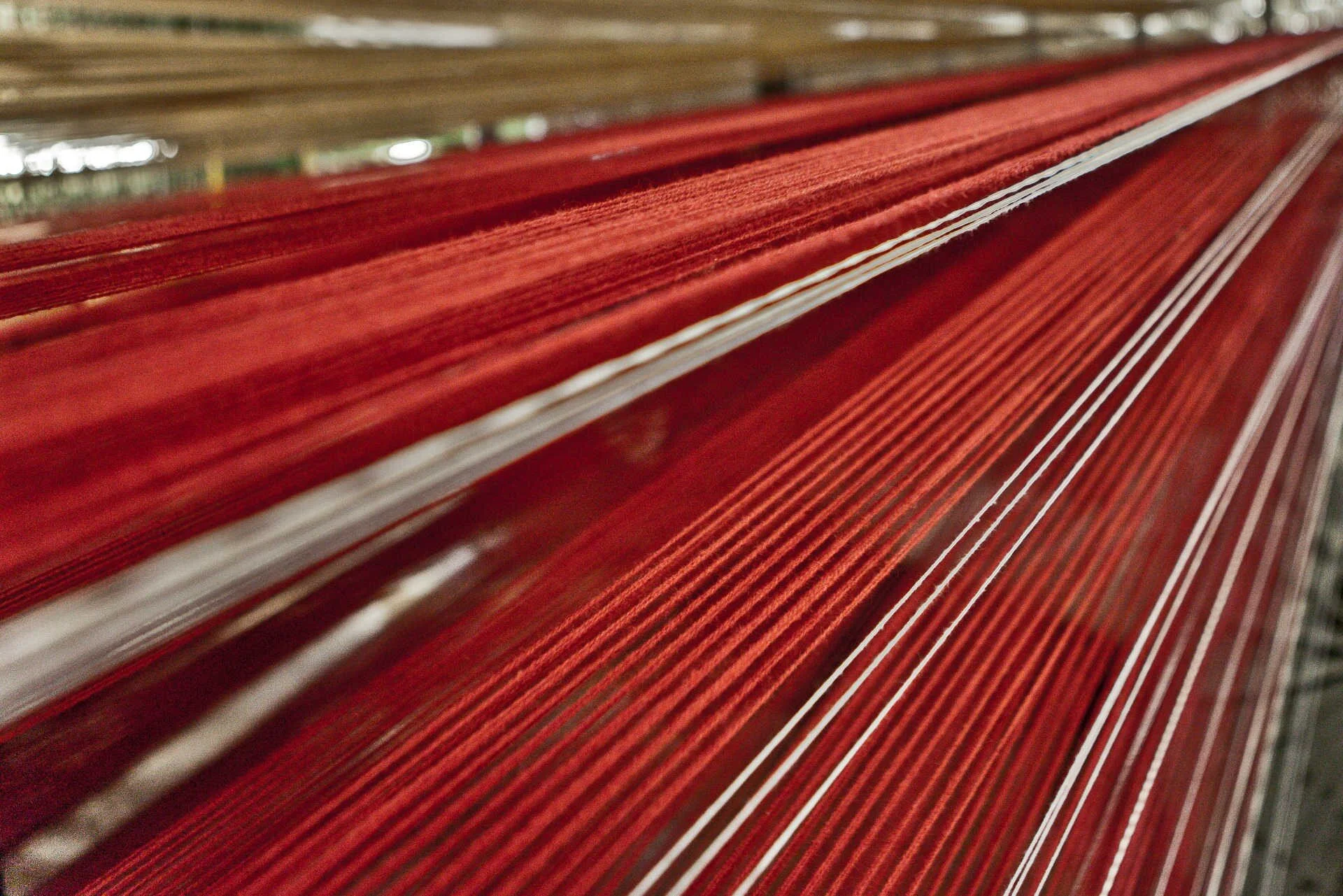
Carpet yarn being fed into a tufting machine at a carpet mill.
A little bit is it to be said about the yarn. Imagine a spool of thread used for sewing, now picture 100 giant spools of thread. Carpet yarn fed into tufting machines are just like those, except they are enormous. Some mills make their own yarn or purchase it from yarn manufactures. Like clothes, the yarn composition determines the look of the carpet. Carpet yarn can vary widely not only in fiber material, but in thickness and amount of twist as well. Carpet for commercial application are generally made with a ticker, denser yarn. The density of a carpet is generally measured in ounces. The amount of twist in the yarn matters too. In a common frieze carpet, because the pile loops are cut, a twisted yarn with a higher twist usually equates to more durability and better “bounce back”.
What Carpet is Made of – Fibers
The material a carpet is made of impacts its performance, appearance, and value. Fibers are what carpet yarn is made from. Each of the different fibers have some form of trade-off. For example, Nylon is generally the most durable, but can also be the most expensive. The lion’s share of today’s carpet is made from synthetic fibers (such as Nylon). Here, we go over the most salient facts about the most prevalent fibers to aid you in selecting which fiber is best for your floors.
Nylon

Nylon is the fiber of choice for red carpet events. In fact, the carpet for the Oscar’s is a Nylon that’s manufactured right here in Georgia. Here, a marine stands guard patrolling on a red carpet at the Vietnam Memorial in Cleveland, OH. (Image from Marines.mil)
Nylon is Nylon, the fiber that changed the game for stockings back in the 1930’s. As back then, Nylon is known for its durability. Among the common synthetic fibers, Nylon is the least likely to stay flattened from compression and lose its bounce. It has the highest resilience among the common artificial fibers. Nylon technology has come so far that you can find Nylon of every feel characteristic. It’s not uncommon to find Nylon today that’s incredibly soft.
The majority of carpet today is made with Nylon. It’s regarded as the most durable fiber among those listed here. It possesses a high resilience, meaning it keeps its bounce and wont stay flattened when compressed. It can stand up to heavy traffic. Modern Nylon carpet can be found in any range of color with incredibly soft feel. Depending on how it was dyed, it can also have strong stain-resistance. Nylon is almost always a solid fiber choice for lasting carpet, but it can come at a cost.
Nylon can range widely in price depending on its characteristics, but is generally an excellent fiber. It is usually more expensive than Polyester and olefin, but less expensive than wool.
Olefin (Polypropylene)
Olefin is just the generic name for polypropylene, which is an everyday plastic (commonly used in packaging, such as yogurt cups and ketchup bottles). It’s frequently utilized due to it’s excellence in economic-to-performance characteristics. While Olefin is fiber favored for its economical value, it is less resilient than Nylon. However, it can still excel as a Berber or other loop pile even in commercial application. It excels in stain resistance and color fastness. It can have a high sheen finish to a more matte appearance. Static build up is not a problem with Olefin carpet.
Olefin is known for being highly stain-resistant, but not soil-resistant. Stain-resistance means spills will not easily chemically alter the Olefin’s dye color. However, if a spill is left uncleaned on your Olefin carpet (it’s soiled) and the material dries, Olefin fibers are prone to being coated by residual material after evaporation. This will cause dirt to be more likely to show. Therefore, olefin is known for being good with spills, but that only holds true if you properly clean your rug when it becomes soiled. Olefin fibers are especially prone to being soiled by oils. Therefore keep in mind that Olefin, while highly stain resistant to water-based spills, is susceptible to oil stains.
In terms of resilience, Olefin is relatively less resilient than Nylon and Polyester. That means its fibers are more likely to retain compression in high traffic areas. However, this characteristic can be mitigated if an olefin rug is tufted as a level-loop, Berber, or dense low-pile carpet. Olefin can also be made to feel very soft to the touch. In total, Olefin is economical but will not last decades in high traffic areas or without sufficient cleaning when spills occur. Because of its value and stain-resistance, Olefin is favored in a wide variety of applications, from rental to commercial to home.
Polyester
In between Nylon and Olefin in terms of resilience, Polyester is also a popular carpet fiber. Like Olefin, Polyester is a highly economical fiber. This is the same Polyester used to make clothes. Generally Polyester can be half the cost of Nylon. However, compared to Olefin, Polyester has two marked differences: Polyester can be dyed well in a broader range of colors (especially bright colors) that are less likely to fade. It’s colorfast in other words. Polyester can also be made to be have an incredibly soft feel.
Polyester has very strong stain resistance, but a touch below Nylon depending how the Nylon was dyed. Polyester is similar to Olefin in that it is highly stain-resistance. But, like Olefin, Polyester has poor but better soil resistance (soil meaning spills left uncleaned that evaporate will leave less residue sticking to the fiber compared to Olefin). In terms of durability, Polyester is less durable than Nylon, but more durable than Olefin. That is, it’s in-between in terms of bounce back or resilience compared to Nylon and olefin. Polyester does not cause static builder unlike Nylon.
One note about Polyester carpet is that it may initially build up a fuzz, which is expected and normal. This depends on how it was manufactured. This is because some Polyester yarn is not made from a completely continuous long strand of string, but rather many small, short strands combined together (referred to as a staple yarn). Not all Polyester carpets will do this, but if they do it is nothing to worry about and will go away. After a few vacuums it will cease from further fuzzing.
Polyester is an economic choice, and often chosen for it’s wide range of colors and softness. It’s not as durable as nylon, but is far more budget friendly. The specific manufacturing process can also make a big difference in terms of level of quality. Polyester is a strong fiber when considering its value, range of colors, stain resistance, and feel.
Wool
While the above fibers can be found in carpets of any grade, Wool is almost exclusively found in extravagant, higher end carpet. Wool is known for its mildew-resistant and antimicrobial qualities. It has a luxurious feel. While not as durable as Nylon, it is still resilient enough to last a long time. Wool carpet is often woven instead of tufted. Wool carpet has the highest cost of any common fiber except Silk Carpet (yes, that exists, too!). Wool as a fiber is more commonly used in rugs than carpet.
Styles of Carpet
The list of carpet styles can go on and on.
You may notice a lot of these categories overlap or blend together. There’s not always a fine line between different styles. It all comes down to the tufted loop construction.
Here are some of the more common categories of carpet styles.
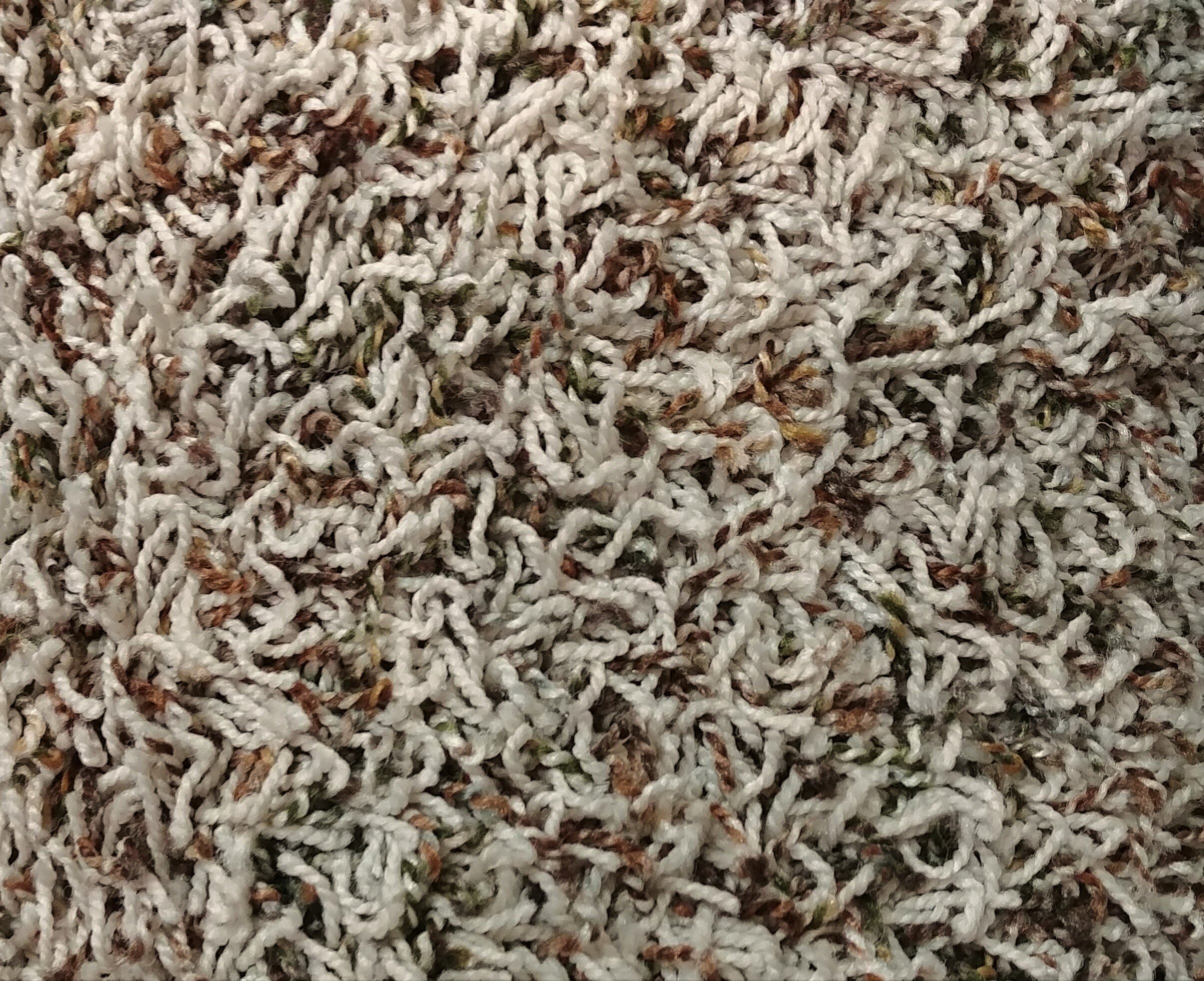
A frieze carpet with the loops cut. This is a shag carpet with a high twist.
Frieze – Friezes are a cut pile carpet with a highly twisted yarn. Shag rugs are a frieze. They are a popular style and can endure high traffic areas. Due to their texture and higher pile, they can hide seams exceptionally well. They are commonly found in the home. They are often found in either solid or speckled patterns.
Plush (Saxony) – Plush carpet is a densely packed level cut-pile carpet. They more uniform and often softer than textures. They have a luxurious look and are often used in more formal areas of the home.
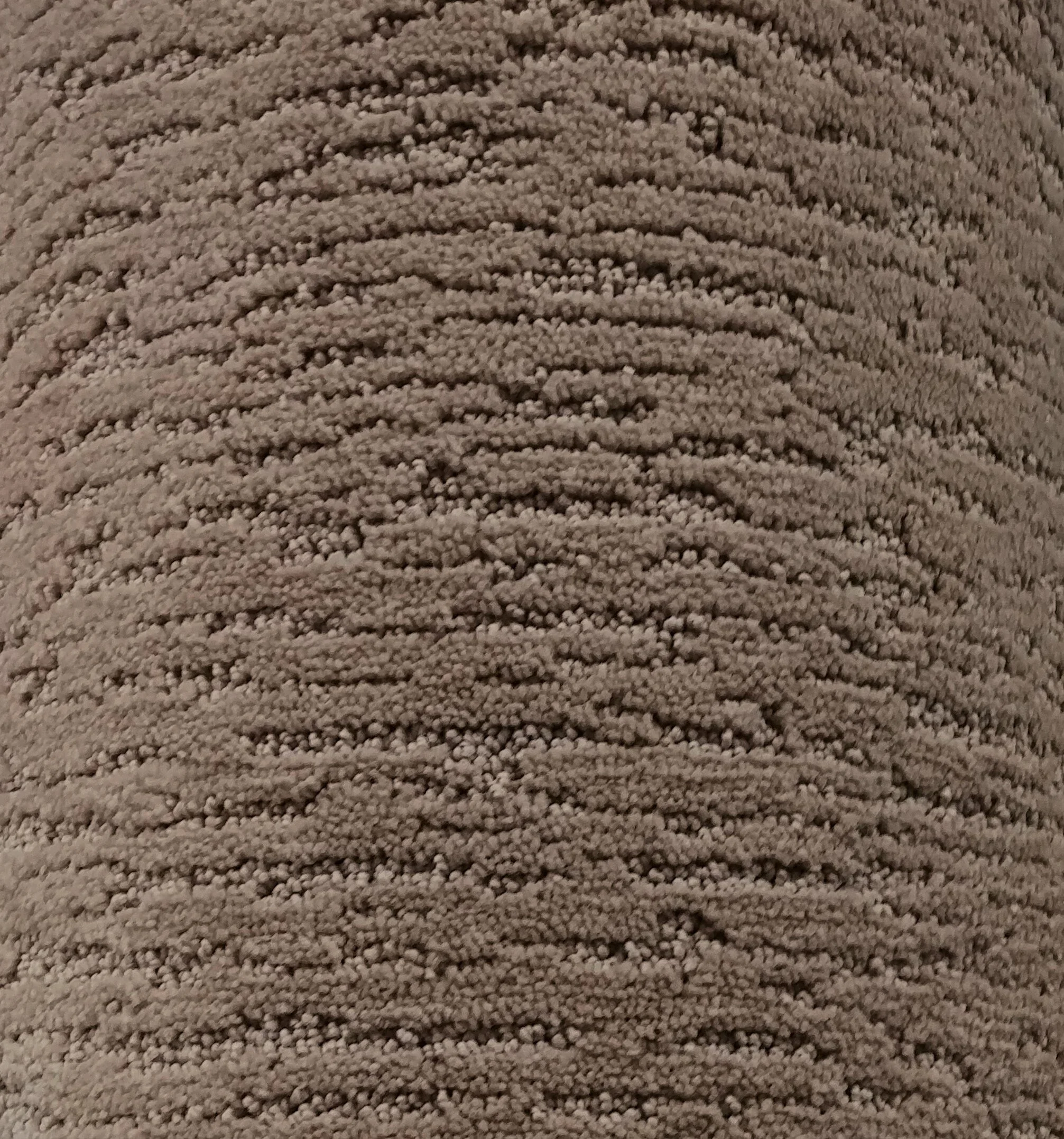
Here is a pattern cut pile carpet. It appears “sculpted” where the loops are left in for stylistic effect.
Pattern Cut Pile (Sculpted) – Also called cut and loop pile or even simply sometimes cut pile, pattern cut pile carpets are made with a mix of cut pile and tight uncut loops. These can be made in any sculpted surface texture or style with an artistic and luxurious appearance. The carpets can be very durable and found with formal and informal looks.
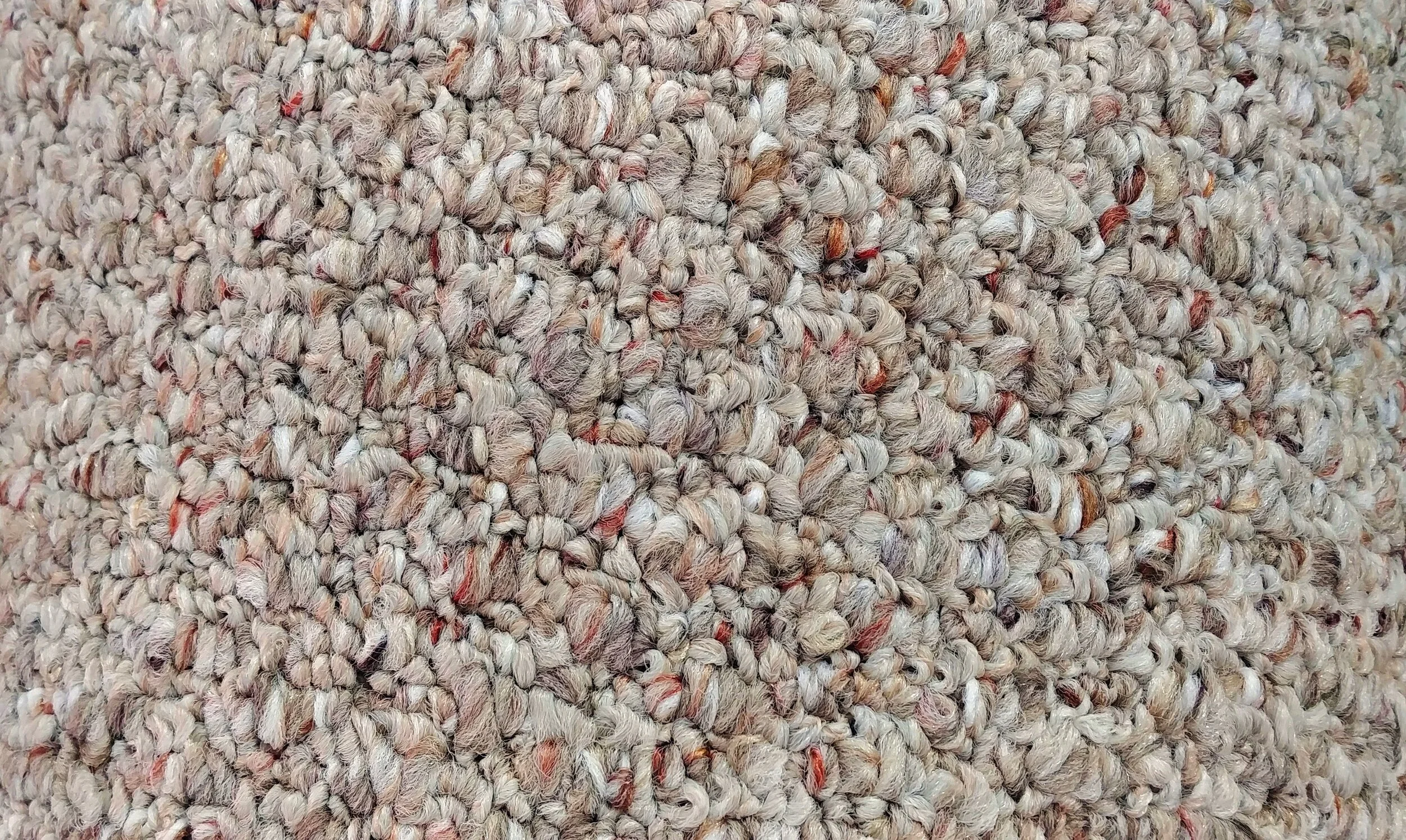
Here is an example of a classic Berber with a speckled look. The carpet is looped and dense. Carpets with the look of Berber can come in all colors, such as solid gray or beige, or any color.
Berber – Berber has taken on the meaning of many types of loop pile carpet. Today, a Berber generally means a loop pile carpet generally made with thicker yarn. They are frequently speckled with various colors for style. Berbers offer excellent durability to foot traffic.
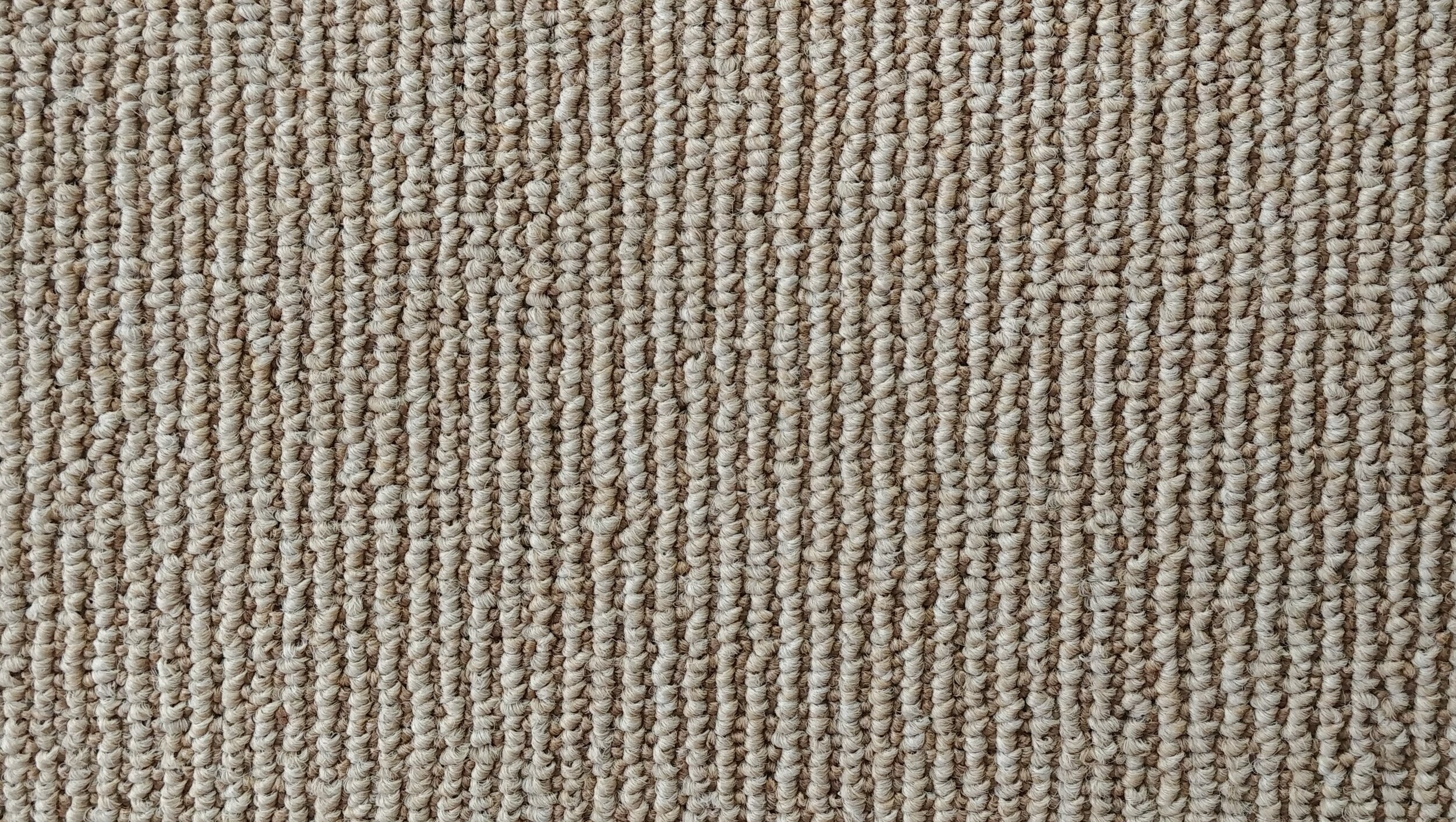
An example of a fundamentally basic multi-level loop carpet. The darker brown stripe has a shorter loop, giving the carpet a striped look. Shorter loops can also be used to create diamond patterns or any other stylistic multi-level pattern.
Multi-Level Loop Pile – These are level loops but with loops of varying heights. The patterns are often a repeating, textured form with various colors. These also excel in durability and can be find in many different commercial and home applications.

A level loop carpet with tight loops in a uniform height. Here’s a rugged carpet you could put in a classroom, office, or porch.
Level Loop Pile – Similar to Berber, level loop usually refers to tightly loop carpet where the loops have a uniform height. It’s widely found in commercial applications, such as schools, government, offices, and libraries. They come in a wide range of styles from solid colors or elaborate patterns.